Hans Lugtigheid
Introduction
Note: The numbers are used as example
With the pandemic we see graphs like this followed by the statement: We are back at the baseline! No more excess mortality, the pandemic is over. Hurray!

This optimism is usually false as we shall see.
Expected and excess mortality
It is always important to know which baseline is used and what the baseline means. I show three baselines as example.
- The first is the estimated mortality which made by the statistics bureau every year. This uses the latest information. Red.
- The second baseline is the average mortality for the years 2016-19. This makes it easy to compare with other countries. Orange.
- With excess mortality people have died who would have died in a later year without, in this case, the pandemic. Thus we have to adjust (lower) the expected mortality, or baseline, in later years. This I call ‘Mortality Displacement’ or ‘Pull Forward Effect’ (PFE). Green.
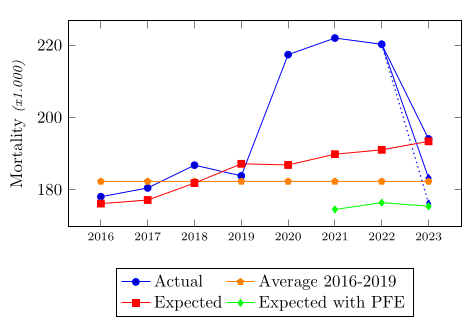
First note how Average and Expected mortality baselines can differ. When calculating excess mortality one uses the baseline also as expected mortality. A baseline which is calculated from mortality from previous years (average, regression etc) can be useful when countries are compared. Yearly calculated expected mortality by the statistics bureau has the potential to be more accurate. Both methods can be adjusted for PFE.
Second, when compared with adjusted for PFE there is still excess mortality (=actual-expected mortality) when actual mortality equals baseline/expected mortality. For the pandemic to be over the actual morality has to be equal to the expected value to compensate for the people who died in earlier years than expected. This is expressed by the blue dotted line.
ASMR
ASMR is a much used statistic to compare years, countries etc. However, when ASMR is used for excess mortality one has to make likewise adjustments.
With ASMR we use for every age group:

Hence for the expected ASMR we has to work with:

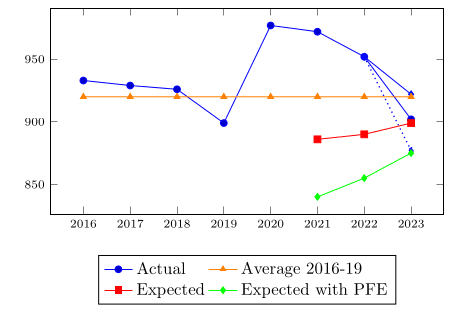
With the term ‘expected # of people to die in an age group’ we have to check and possibly adjust the numbers for PFE. It is just as with the raw numbers above and we see a likewise pattern for ASMR.
Conclusion
When working with excess mortality and before concluding that the pandemic and/or excess mortality is over we have to ask questions like:
- Which baseline/expected mortality are we using? How do we value the derived excess mortality?
- With excess mortality how many people that died prematurely we estimate would have died in what later year? Should we adjust expected mortality for PFE?
- When using ASMR to analyse excess mortality: Have we checked for the informative value of the baseline? For PFE?
This article is licensed under:
Creative Commons Attribution 4.0 International