Hans Lugtigheid
Introduction
With the pandemic we have seen that excess mortality can be calculated in different ways. In this article we give a method that calculates the excess mortality per year. This method takes into account that excess mortality in one year can influence the expected mortality, and hence the excess mortality, in subsequent years. We also show possible definitions of excess mortality.
Preliminaries
The expected mortality usually is calculated on the base of the past. The excess mortality is calculated as actual mortality minus the expected mortality.
When there is excess mortality in a single year, for instance because of a flu outbreak, than mortality in the next year is lower than normally expected. Usually the expected mortality is not adjusted, but one explains the lower than expected mortality by the flu the year before. With the corona pandemic we had a phenomenon that spread over multiple years. Than the excess mortality gets less clear.
An example.
In a country 150K people die every year. In a year there is a strong flu and 10K elderly people die who would otherwise have died the next year. Mortality in the first year is 160K. So it is to be expected that in the next year 140K people die, 10K less then normal. Suppose that in the second year 152K people die. Then excess mortality for the second year is usually calculated as 152K – 150K = 2K. When we adjust the expected mortality on January 1 to 140K the excess mortality becomes 12K. A significant difference. See table 1.
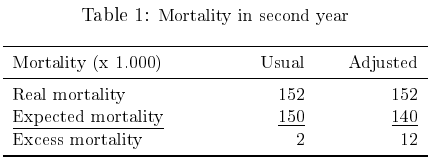
On January first of the second year we have information on the pandemic in the previous year. We can use this information to adjust the ‘normal’ expected mortality. Then we get the expected mortality given the number of people that have died a year earlier. Then we get a more accurate picture of excess mortality. When the pandemic stretches over multiple years we must adjust expected mortality every year on January first. For the expected mortality in the third year we have people who have died in the first year and would have died in the third year without pandemic. There are also people who died in the second year who would have died in he third year without the pandemic. We have to adjust the expected mortality in the third year for both these numbers. Etcetera.
The model
Excess mortality is calculated as actual mortality minus expected mortality. So we have to determine the expected mortality for every year.
We assume a pandemic. At the beginning of every year we calculate/estimate for every year the expected mortality given the excess mortality in previous years.
In order to calculate/estimate the expected mortality for every year we have to distribute the excess mortality in every year over the subsequent years in which people would have died without the phenomenon/pandemic.
We determine the expected mortality and the excess mortality in four steps.
Step 1: Year 0
We start with year 0. See table 2.
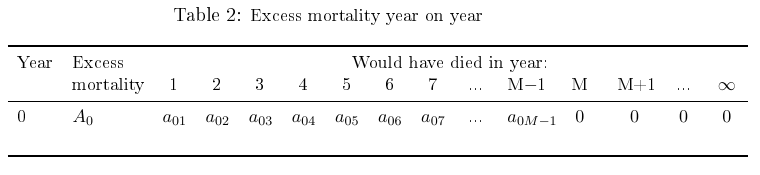
Explanatory notes with table 2:
Column 1
Relevant year
Column 2
Excess mortality in the year. A0 = excess mortality in year 0.
Column #
In those columns we note the number of people who died in year 0 but without the pandemic would have died in that year. Or: would have lived until that year. So with year 5 a05 is the number of people that has died in the year 0 and without the pandemic would have died in year 5.
Column M
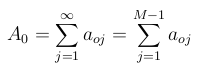
M is the maximum age one can reach. If someone is born in the year 0 then one can live maximally until the year M-1. Then the value from M and up in this row equals 0.
Column ∞
It is not known how many years an event will occur. Hence the table goes to ∞. In practice when applied one shall work with a finite number of years.
We have the following relations:
Step 2
We add the subsequent years. See table 3.
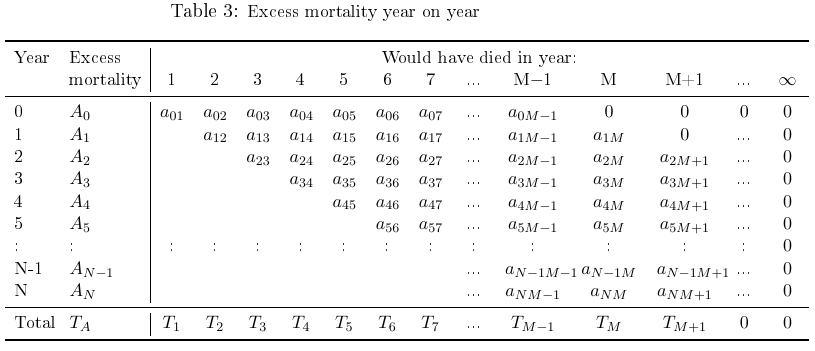
Explanatory notes with table 3
Aj
Excess mortality in year i.
N
Number of years a phenomenon takes and/or has influence.
aij
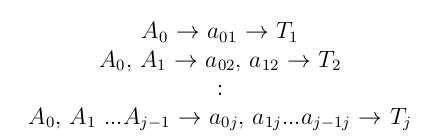
Number of people that died in year i that would have died in year j without the phenomenon. So a37 is the number of people that died in year 3 en without the phenomenon would have died in the year 7. These numbers are unknown. They have to be estimated for every year.
Tj
Total number of people that would have died in year j but because of the phenomenon died in earlier years. Tj is the amount with which we adjust the expected mortality for year j.
M
At year 0 one lives maximally M years until the year M-1 and its value from year M and up equals 0. From year 1 one lives maximally M years until the year M and its value from year M+1 and up equals 0. Etcetera.
We have the following relations:


Thus the sequence becomes:
Step 3: Expected mortality
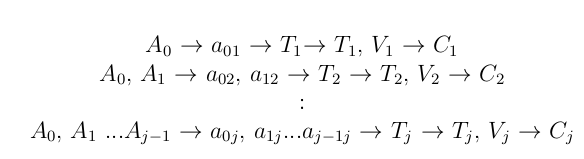
We determine the new expected mortality (Cj) by correcting the old, pre-pandemic, expected mortality (Vj) with the earlier calculated adjustment (Tj).
In formula: Cj = Vj – Tj
Then the sequence becomes:
Step 4: Excess mortalityp
Determine new excess mortality.
We used to determine old excess mortality (Oj) with actual mortality (Sj) and old expected mortality (Vj).
In formula: Oj = Sj – Vj
Now we determine the new excess mortality in year j, (Aj) with the actual mortality (Sj) and the new expected mortality (Cj).
In formula: Aj = Sj – Cj
The sequence becomes:
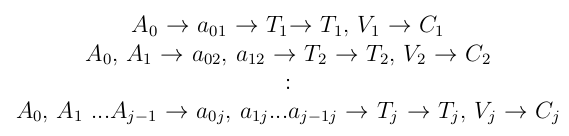
Note that we use the calculated excess mortality Aj as input for table 3.
The difference between old and new excess mortality equals Tj.
In formula: Aj = Oj + Tj
Excess mortality in the same year
People also can die by a phenomenon who would have died otherwise later in the same year. Say an older person who dies from the pandemic in April but otherwise would have died in October. This is premature mortality and can also be qualified as excess mortality. One can choose to add this to the earlier calculated year-on-year mortality. Then we get a new definition of excess mortality.
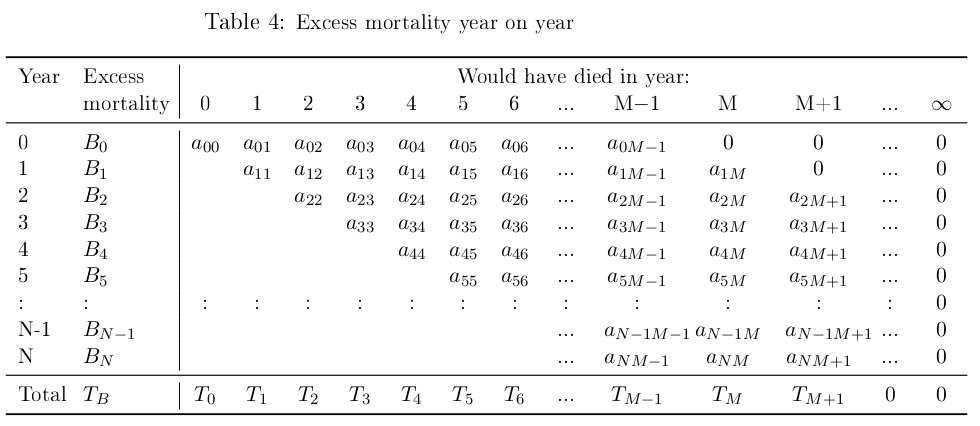
Explanatory notes (additional) with table 4:
Bi
Excess mortality in year i. This includes excess mortality in the same year.
aii
Excess mortality in same year i.
T0
Excess mortality in year 0. Is equal to a00.
Relations:

with Ai excess mortality year-on-year as in table 3.
Conclusion
The given model gives a way to calculate excess mortality in multiple years. The model consider the fact that the (excess) mortality in a year can influence expected and excess mortality in later years. One can use different definitions of expected and excess mortality. When using this method it is important to make very clear which definitions are used. The method gives a good overview of expected and excess mortality as a consequence of a phenomenon that occurs over multiple years.

This work is licensed under a
Creative Commons Attribution 4.0 International License.